If you’ve ever watched the clock run out on a hockey game with both teams at the same score, you may have wondered whether hockey games can end in a tie.
In the NHL, they can’t — at least not anymore.
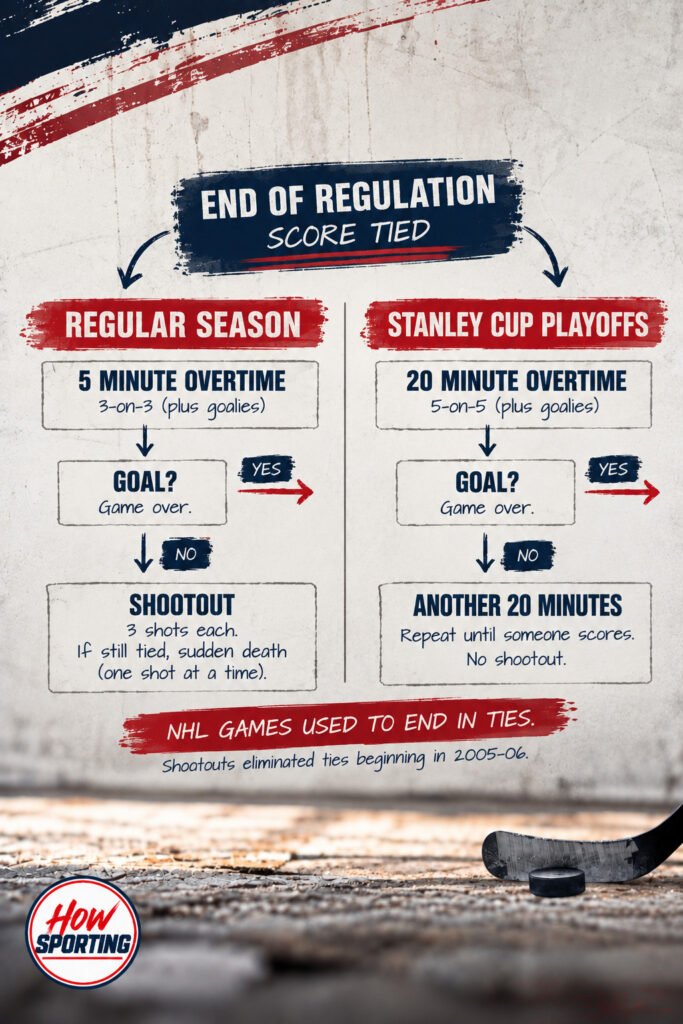
During the regular season, a game that is tied at the end of regulation goes into overtime. If neither team scores during overtime, the game is decided by a shootout. During the Stanley Cup Playoffs, the rules are different: there are no shootouts, and the teams keep playing overtime periods until someone scores.
It wasn’t always this way, though. NHL games could end in ties until the league introduced the shootout for the 2005–06 season.
What Happens When an NHL Game Is Tied?
An NHL game consists of three 20-minute periods. If the score is tied at the end of the third period, the game moves into overtime.
During a regular-season game, overtime is five minutes long and is played three-on-three. The first team to score wins the game.
If the five-minute overtime period ends without a goal, the teams move on to a shootout.
How Does the NHL Shootout Work?
Each team chooses three players to take a shot against the opposing goalie. The teams alternate attempts, and the team with the most goals after those three rounds wins.
If they’re still tied after three rounds, the shootout continues one round at a time until one team scores and the other doesn’t.
The shootout is only used during regular-season NHL games. You won’t see one during the Stanley Cup Playoffs.
What Happens in the Standings After Overtime?
The NHL uses a points system for the league standings.
A team earns two points for a win, whether that win happens during regulation, overtime or a shootout. A team that loses during regulation doesn’t receive a point.
However, a team that loses in overtime or a shootout receives one point. This is why NHL standings have an OTL column for overtime losses.
It can be a little confusing at first because an overtime loss is still a loss, but the team receives a point because the game was tied at the end of regulation time.
Can a Playoff Hockey Game End in a Tie?
No. NHL playoff games also continue until there is a winner, but the overtime format is very different.
If a Stanley Cup Playoff game is tied after regulation, the teams play a full 20-minute sudden-death overtime period. Playoff overtime is played five-on-five rather than using the three-on-three format from the regular season.
The first goal ends the game.
If the score is still tied after that overtime period, the teams play another one. There is no shootout and no set limit to the number of overtime periods that can be played.
That’s why playoff games can occasionally get very long. They simply continue playing until someone scores.
Why Doesn’t the NHL Use Shootouts in the Playoffs?
A regular-season shootout provides a relatively quick way to settle a tied game during an 82-game season. In the playoffs, however, the game continues under regular five-on-five hockey rules until one team scores.
That means a playoff game is ultimately decided through regular team play rather than a series of one-on-one shootout attempts.
It also means there is no predicting exactly how long a playoff game will last. A sudden-death goal could come quickly, or the game could continue through several overtime periods.
Did NHL Games Used to End in Ties?
Yes. If you’re looking at older NHL records or standings, you may see ties listed alongside wins and losses.
The NHL used several different overtime formats over the years, but regular-season games could still end in a tie if neither team scored during overtime.
That changed for the 2005–06 season when the NHL introduced the shootout. From that point on, every regular-season game would have a winner.
The overtime format has continued to change since then. The NHL introduced three-on-three overtime for the 2015–16 season, replacing the previous four-on-four format.
What About Other Hockey Leagues?
Not every hockey league uses exactly the same overtime rules as the NHL.
Minor hockey, international hockey, college hockey and other professional leagues can have their own rules for overtime periods, shootouts and tournament games. The format can also depend on whether the game is part of a regular season, tournament or playoff.
So if you’re watching something other than an NHL game, it’s worth checking the rules for that particular league or competition.
So, Can Hockey End in a Tie?
If we’re talking about today’s NHL, no.
A regular-season game that is tied after three periods goes to a five-minute, three-on-three overtime period. If it’s still tied, the game is decided in a shootout.
During the Stanley Cup Playoffs, a tied game goes to 20-minute, five-on-five sudden-death overtime periods and continues until one team scores.
Older NHL games could end in ties, which is why you’ll still find them in historical records. But under the current NHL rules, every game ends with a winner.